
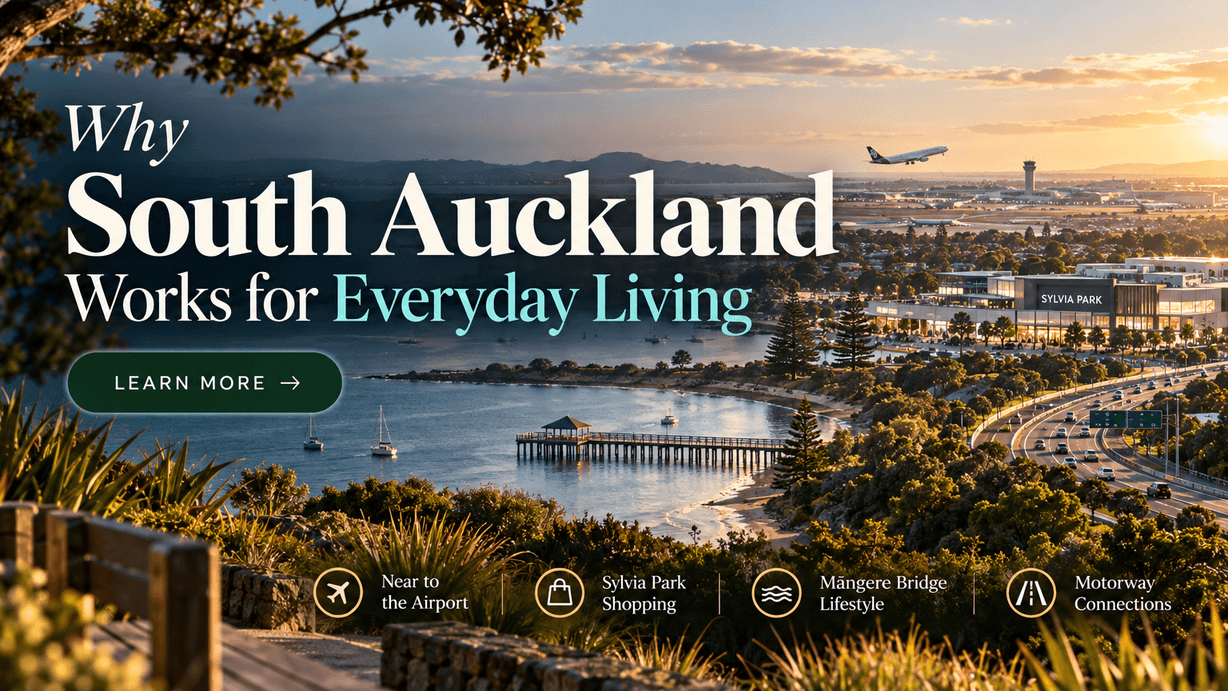
If you are thinking about buying a home in Auckland, South Auckland will probably appear in your search sooner or later.
But that usually leads to a bigger question:
Is South Auckland actually a good place to live?
The answer depends less on the label “South Auckland” and much more on where you work, how you travel, the type of home you need and what you want around you every day.
South Auckland includes established neighbourhoods with very different personalities. Māngere Bridge offers a village and foreshore lifestyle. Māngere East provides convenient access to major employment areas. Manurewa combines rail connections, established shopping and substantial green space.
For many home buyers, particularly those already working or spending much of their time in the south, the area can offer a practical combination of connectivity, employment access, established amenities, recreation and modern housing options.
But it should still be evaluated suburb by suburb - and property by property.
If you are specifically approaching the area as a first-home buyer, our existing First Home Buyer South Auckland Guide goes deeper into Māngere East, Māngere Bridge and Manurewa from a buying perspective.
South Auckland is not one neighbourhood
One of the biggest mistakes home buyers can make is treating all of South Auckland as though it offers the same lifestyle.
It does not.
Māngere Bridge, for example, has a distinctly different feel from Māngere East or Manurewa. The neighbourhood combines Māngere Bridge Village, cafés, the foreshore and access toward SH20. Homes by Pillar’s local area information describes the suburb as a village by the foreshore with quick motorway access toward both Auckland Airport and the city.
Manurewa offers something different again. It is an established suburb connected to the rail network and positioned close to large recreation areas including Auckland Botanic Gardens and Tōtara Park. Homes by Pillar also identifies Southmall and access to SH1 among the suburb’s practical advantages.
That means the better question is not simply:
“Should I live in South Auckland?”
It is:
“Which part of South Auckland fits my everyday life?”
That distinction matters.
1. Living close to major employment areas can make everyday life easier
Location becomes much more valuable when it reduces the amount of time you spend getting to work.
South Auckland contains or sits close to several major employment areas, including Auckland Airport, Manukau, Middlemore Hospital, Ōtāhuhu and surrounding industrial and commercial precincts.
Auckland Airport describes its precinct as one of Auckland’s largest and fastest-growing employment areas, with thousands of jobs across the airport and surrounding businesses. Its Ara jobs and skills hub works with more than 100 employer partners across the precinct.
Middlemore Hospital is another major South Auckland employment and health-services hub. Health New Zealand describes it as the largest and busiest hospital in South Auckland, with extensive inpatient, outpatient and specialist services.
For someone working around the airport, Middlemore, Manukau or the wider south, buying closer to work can materially change everyday life.
A property that appears further from Auckland CBD may actually be more conveniently located for your personal routine than a home further north.
This is why commute should be assessed from your workplace - not automatically measured from Queen Street.
2. South Auckland has several useful transport connections
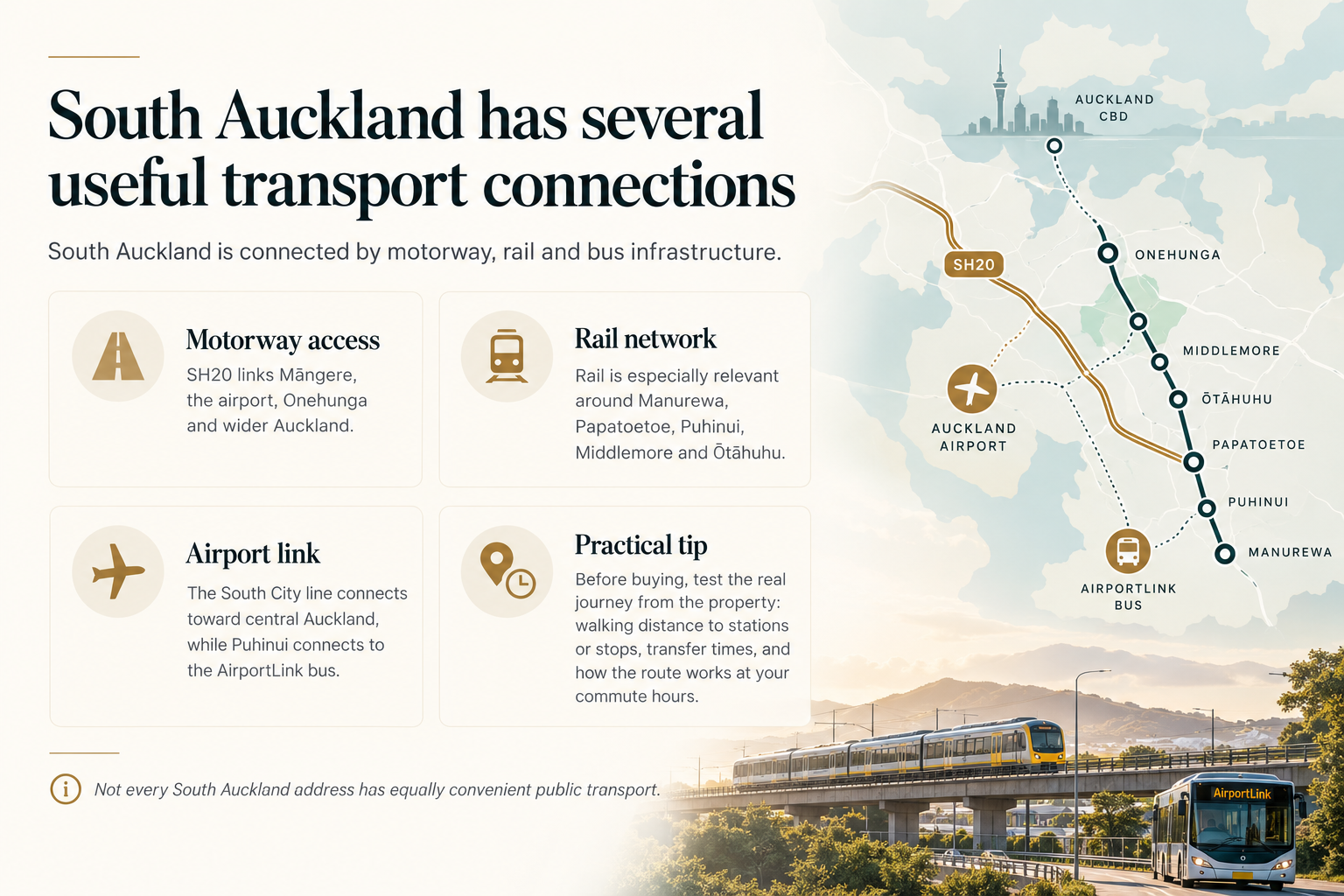
Another advantage is that South Auckland is connected by a combination of motorway, rail and bus infrastructure.
SH20 provides an important connection between Māngere, the airport, Onehunga and wider Auckland. NZ Transport Agency says the Manukau Harbour Crossing improvements were specifically designed to improve travel between south and central Auckland and access to Auckland Airport.
Rail is particularly relevant around Manurewa, Papatoetoe, Puhinui, Middlemore and Ōtāhuhu.
Auckland Transport’s South City train line connects South Auckland with destinations toward central Auckland, while Puhinui provides a connection to the AirportLink bus.
AirportLink currently operates between Auckland Airport, Puhinui Station and Manukau Bus Station. Auckland Transport says passengers can transfer at Puhinui between the airport bus and the wider rail network.
That does not mean every South Auckland address has equally convenient public transport.
Before buying, test the actual journey from the property you are considering. Look at walking distance to stops or stations, transfer times and how the route works at the hours you genuinely commute.
3. Established amenities can make daily life more convenient
New housing on the edge of a city can sometimes arrive before the surrounding amenities do.
Much of South Auckland has the opposite advantage: these are established communities where supermarkets, town centres, healthcare, schools, parks and local services already exist.
Māngere Bridge has its village centre alongside supermarkets, cafés and recreational facilities. Pillar’s current Māngere Bridge development information highlights access to the village, supermarkets, parks, public transport and motorway connections.
Māngere East provides access toward Māngere Town Centre while also sitting within reach of Papatoetoe, Ōtāhuhu, Middlemore Hospital and the airport corridor. Pillar’s current development information for Tennessee Avenue identifies shopping, schools, local eateries, healthcare and transport connections as nearby amenities.
Manurewa has long-established shopping, schools and community facilities along with its railway station and motorway connections.
These are not necessarily the features that photograph best in a property advertisement.
But after you move in, having groceries, healthcare, transport and everyday services within practical reach can matter more than a fashionable postcode.
4. There is more outdoor lifestyle than many buyers expect

South Auckland also has significant outdoor and recreational spaces.
Māngere’s foreshore provides walking and recreation around the Manukau Harbour. Auckland Council’s Māngere Foreshore Path runs from Ambury Regional Park along the coastal edge and connects with the wider landscape around the harbour.
Ngā Hau Māngere also provides a dedicated walking, cycling and recreational connection across the harbour between the Māngere Bridge and Onehunga communities.
Further south, Tōtara Park covers around 216 hectares and includes walking trails, mountain-biking opportunities, recreation facilities and direct proximity to Auckland Botanic Gardens.
Auckland Council also highlights the Botanic Gardens, Tōtara Park and coastline among Manurewa’s major recreational assets.
For a buyer deciding between a larger private section and a lower-maintenance home, having quality public green space nearby can change the equation.
You may not need a huge backyard to have good access to outdoor space.
5. Māngere Bridge, Māngere East and Manurewa offer different lifestyles
This is where South Auckland becomes more interesting from a home-buying perspective.
Māngere Bridge can suit buyers who value a more established village environment, the foreshore and convenient SH20 access.
Homes by Pillar currently has new homes available at 114 Coronation Road, Māngere Bridge, combining modern new-build living with access to the village, parks, motorway connections and Auckland Airport.
Māngere East may appeal more to people whose priorities include Middlemore Hospital, the airport employment area, Māngere, Papatoetoe or Ōtāhuhu.
The current 31 Tennessee Avenue, Māngere East development offers modern two-bedroom freehold homes and is positioned within reach of schools, shopping, Middlemore, SH20 and Auckland Airport.
Manurewa East provides another combination: access to the wider Manurewa community, motorway connections, rail, parks and established amenities.
Buyers can currently explore 16–18 Lincoln Road, Manurewa East, where Pillar has completed new-build homes available now.
None of these locations is automatically “better”.
They solve different problems for different households.
6. The right home matters as much as the right suburb
Location should never be considered on its own.
A suburb may work perfectly for your commute, but the home itself still needs to suit your budget and lifestyle.
For first-home buyers, that can mean thinking differently about what the first property needs to provide.
Do you genuinely need four bedrooms immediately?
Would two bedrooms plus flexible living space be enough?
Would you prefer a modern, lower-maintenance home over an older property that may need renovation?
Would living closer to work be more useful than owning additional land?
These questions can change the type of property that makes sense.
Our First Home Buyer Auckland guide explores how home size, location, new-build options and affordability can interact when choosing your first property.
And if the main barrier is the deposit rather than the location, our guide Could $25,000 Be Enough to Start Buying Your First Home? explains KiwiSaver, lower-deposit pathways and borrowing capacity in more detail.
7. Affordability should include the cost of your lifestyle
A property's purchase price is only one part of affordability.
Suppose one home costs less but adds significant commuting time and fuel expense every week.
Another might require substantial renovation shortly after settlement.
Another might stretch your mortgage so far that normal living becomes uncomfortable.
Those costs matter.
A good home-buying decision should consider mortgage repayments alongside rates, insurance, maintenance, transport and the normal costs of running your household.
This is particularly important for first-home buyers, because being approved for the maximum amount a lender will consider does not automatically mean borrowing that maximum will produce the lifestyle you want.
If you are currently renting and trying to decide whether ownership makes sense, read our detailed Renting vs Buying in Auckland guide.
For buyers looking at lower-deposit pathways, our 5% Deposit for First Home Buyers guide explains why the deposit hurdle and mortgage-servicing hurdle need to be considered separately.
What should you check before buying in South Auckland?
This is also where an article about South Auckland needs to be realistic.
A suburb name alone should never determine whether you buy a property.
Visit the street more than once. Try the commute during peak traffic. Check parking. Look at public transport at the times you would actually use it. Confirm school zones directly. Have your solicitor review the title and sale documents. Review the LIM and relevant natural-hazard information. Understand insurance availability and the condition of the particular home.
That advice applies throughout Auckland.
It is especially important when buyers make broad assumptions - positive or negative - about an entire part of the city based on reputation rather than investigating the actual property.
A good purchasing decision happens at property level, not postcode level.
What if South Auckland is not the right fit?
One useful approach is to compare South Auckland against other Auckland locations rather than evaluating it in isolation.
Homes by Pillar’s current portfolio also gives buyers options at 9 Glenside Avenue, Pakuranga in East Auckland and 2 Fairlands Avenue, Waterview closer to central Auckland.
In West Auckland, buyers can compare 16 Geneva Place, Blockhouse Bay, 47 Yeovil Road, Te Atatū Peninsula and the larger standalone home at 84 Matipo Road, Te Atatū Peninsula.
On the North Shore, there is also 16 Dallinghoe Crescent, Milford.
Current availability changes, so buyers should always check the live Homes by Pillar developments page before making decisions. The current site lists available homes across South, East, Central, West Auckland and the North Shore.
This comparison is useful because it forces you to ask the right question:
What am I actually getting for the location I choose?
So, is South Auckland a good place to live?
For many households, South Auckland can be a very practical place to live, particularly when work, family or everyday life is already centred around Māngere, Manukau, Middlemore, the airport corridor or southern Auckland.
Its advantages can include established neighbourhoods, motorway and rail connections, major employment areas, shopping and services, large parks and recreational spaces, and a growing range of modern housing.
But South Auckland is too large and varied for a blanket answer.
Māngere Bridge does not offer exactly the same lifestyle as Māngere East.
Manurewa has different transport and recreation advantages again.
The best approach is to compare the suburb against your actual daily routine - not somebody else's perception of the area.
If the home works for your budget, the location reduces friction from your everyday life and the neighbourhood provides the amenities you value, South Auckland deserves serious consideration.
For buyers ready to explore the area in more detail, continue with our First Home Buyer South Auckland Guide: Māngere, Māngere Bridge & Manurewa or review the step-by-step guide to buying a house in New Zealand.